A fire risk assessment for care buildings is a mandatory, systematic evaluation that identifies fire hazards, assesses risks to vulnerable occupants, and establishes protective measures to ensure regulatory compliance. Under the Regulatory Reform (Fire Safety) Order 2005, every care building must have a suitable and sufficient assessment in place. Failure to comply can lead to enforcement action, prosecution, unlimited fines and, in the most serious cases, imprisonment. The Care Quality Commission (CQC) requires documented evidence of assessments during inspections, making this a non-negotiable compliance obligation for every facility manager and compliance officer in the sector.
What is a fire risk assessment for care buildings?
A fire risk assessment is the formal process by which the responsible person in a care building identifies hazards, evaluates risks, and puts control measures in place to protect occupants and the premises. The industry standard term is “fire risk assessment,” and it carries a specific legal meaning under the Regulatory Reform (Fire Safety) Order 2005. Generic health and safety audits do not satisfy this requirement.
Care buildings fall into a distinct risk category. Residents may have limited mobility, cognitive impairments, or complex medical needs that make self-evacuation impossible. A standard commercial assessment does not account for these factors. The CQC requires evidence of Personal Emergency Evacuation Plans (PEEPs) for any resident who needs support to evacuate. Without them, a care building is exposed to both regulatory sanction and, more critically, preventable harm.
The assessment must be specific to the building, its occupants, and its operational patterns. A care home operating 24 hours a day with sleeping residents at night presents a fundamentally different risk profile from a daytime office. That distinction must be reflected in every section of the documented assessment.
What are the key steps in a fire risk assessment for care buildings?
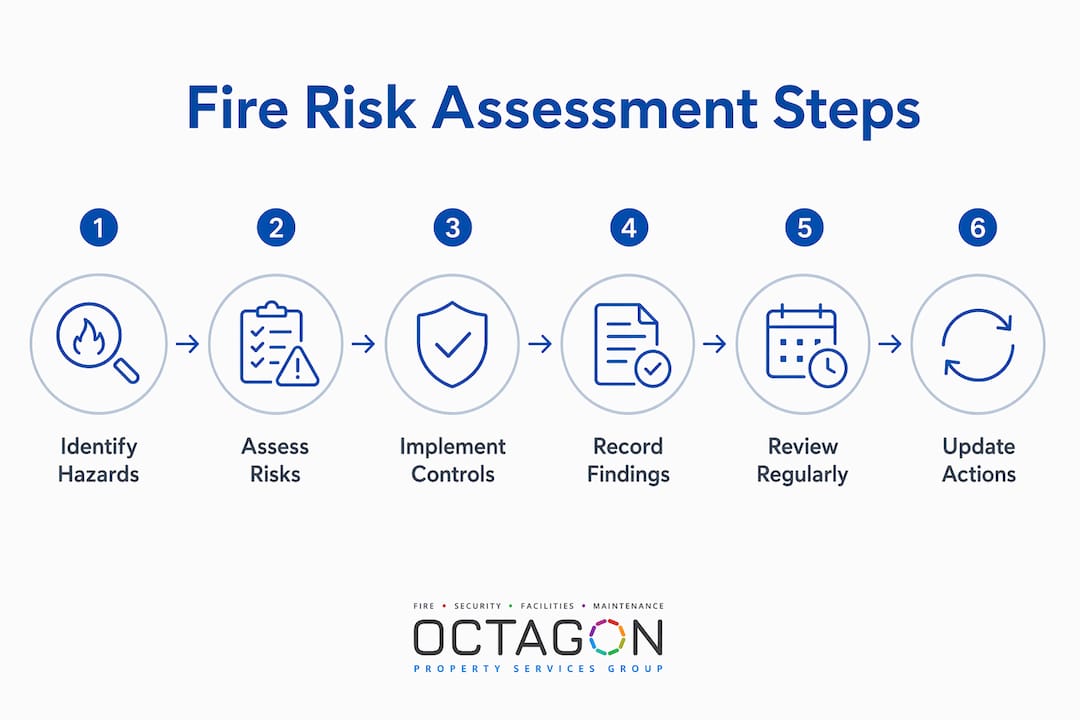
The responsible person must follow a structured five-step process to produce a legally compliant assessment. Each step builds on the last, and skipping any one of them creates gaps that regulators and insurers will identify.
The five-step process
- Identify fire hazards. Locate ignition sources such as electrical equipment, cooking appliances, and smoking areas. Identify fuel sources including bedding, furnishings, and stored materials. Note oxygen sources that could accelerate a fire.
- Identify people at risk. Map every person in the building, including residents with mobility limitations, night-shift staff, and visiting contractors. Produce individual PEEPs for residents who cannot self-evacuate.
- Evaluate and reduce risks. Remove hazards where possible. Where removal is not possible, put control measures in place: fire-resistant materials, separation of ignition and fuel sources, and staff protocols.
- Record findings and plan emergency actions. Document all findings, assign responsibilities, and set deadlines for corrective actions. Produce a written emergency plan covering evacuation routes, assembly points, and staff roles.
- Review and update regularly. Treat the assessment as a live document. Update it after any significant change to the building, its occupants, or its fire safety systems.
A documented record of findings must be maintained when five or more employees are present or when the premises are licensed. That record must be securely accessible at all times.
💡 OPSG Pro Tip: Build your fire risk assessment checklist around the five steps above, but add a sixth column for each item: “date actioned.” Regulators look for evidence that findings were acted upon, not just recorded.
How often should fire risk assessments be reviewed in care buildings?
Review frequency is not optional. PAS 79:2020 guidance recommends reviewing assessments at least every six months for high-risk settings such as care homes, or immediately following any significant change. That six-month interval reflects the dynamic nature of care environments, where resident dependency levels, staffing, and building layouts can shift rapidly.
The following circumstances require an immediate reassessment:
- A change in building layout, including new extensions or internal reconfigurations
- A significant increase or decrease in bed capacity
- A change in the dependency levels or mobility of residents
- Installation or modification of fire detection or suppression systems
- A fire incident, near-miss, or enforcement notice
- Maintenance issues that affect compartmentation or escape routes
Facility managers often underestimate how quickly a care building’s risk profile can change. A single new resident with complex mobility needs can alter the evacuation time calculation for an entire floor. That change must be captured in the assessment before it becomes a compliance gap.
💡 OPSG Pro Tip: Set a calendar reminder for a six-monthly review as a minimum. After any of the triggers listed above, treat a reassessment as urgent, not scheduled.
What specific fire risks make care buildings different from other premises?
Care buildings carry a higher risk profile than most other occupied premises. 24-hour occupancy with sleeping residents means a fire at 3:00 AM presents evacuation challenges that a daytime office simply does not face. Generic assessments consistently fail to account for actual evacuation times in these settings.
Unique risk factors in care environments
The table below summarises the key risk factors specific to care buildings and their implications for the assessment.
| Risk factor | Implication for assessment |
|---|---|
| Limited resident mobility | Evacuation times are longer; PEEPs are mandatory for affected residents |
| Cognitive impairments | Residents may not respond to alarms; staff must initiate and manage evacuation |
| 24-hour occupancy | Night-time staffing levels must be validated against real evacuation needs |
| Horizontal evacuation strategy | Compartmentation integrity must be verified; fire doors must be fully functional |
| Fire detection system | Most care homes are designed with L1 fire detection systems in accordance with BS 5839-1, although the appropriate category should always be determined by the building’s fire risk assessment and design. |
Staffing levels at night are one of the most frequently overlooked elements in care home assessments. An assessment must validate whether the number of staff on duty can physically evacuate all residents within the time available under the building’s specific layout. Relying on generic evacuation guidance produces non-compliant outcomes.
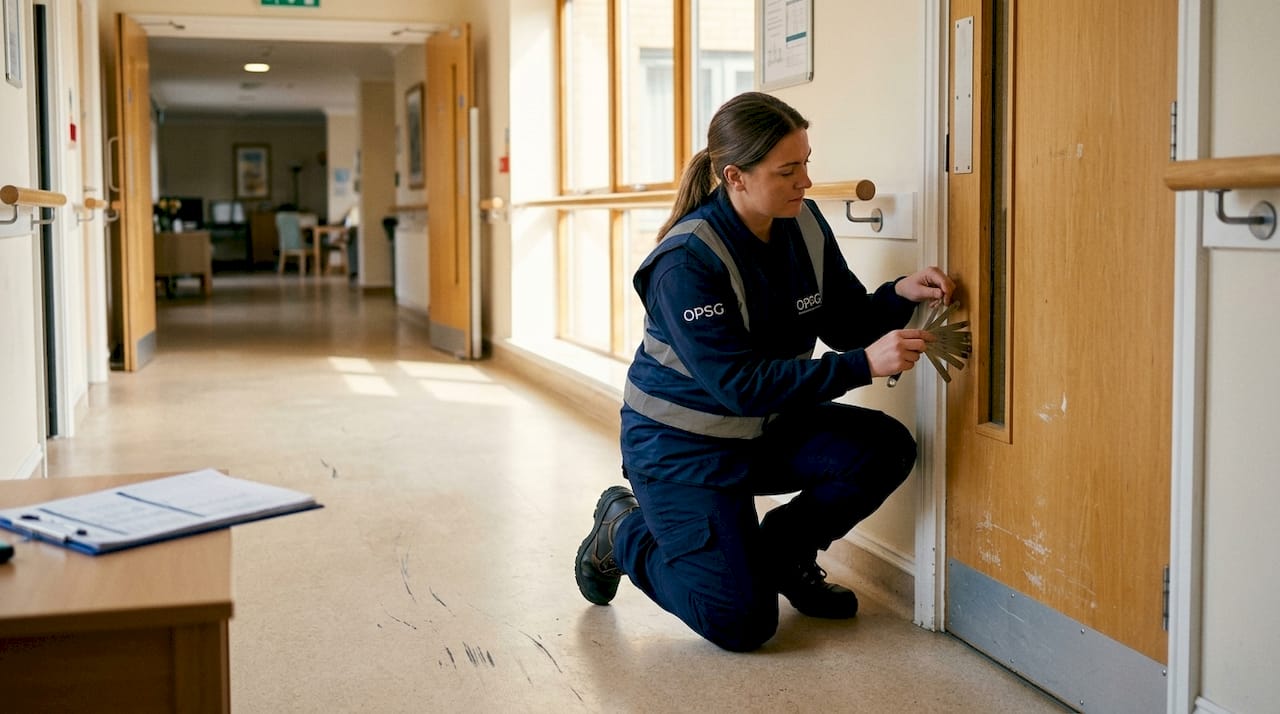
Fire compartmentation integrity is equally critical. Assessors must inspect every fire door and check all service penetrations for breaches. A single unsealed cable penetration through a compartment wall can undermine an entire horizontal evacuation strategy. OPSG’s fire door inspection work addresses exactly this type of risk in care and healthcare settings.
Who should conduct fire risk assessments in care buildings?
The responsible person in a care building is typically the registered manager or provider. That person carries legal accountability for the assessment under the Regulatory Reform (Fire Safety) Order 2005. However, legal accountability does not mean the responsible person must personally carry out the assessment. The requirement is that the assessment is conducted by a competent person with adequate training, experience, and knowledge of the specific risks in care environments.
Competency in this context means more than completing a short course. An assessor working in care buildings must understand:
- The specific evacuation challenges posed by residents with mobility and cognitive limitations
- The requirements for L1 fire detection systems and compartmentation under BS 5839-1
- How to produce defensible PEEPs that satisfy CQC inspection criteria
- The documentation standards required for regulatory and insurance audits
- How to identify when a previous assessment is no longer suitable or sufficient
Missing documentation and outdated training records are the two most common issues identified during CQC and fire authority inspections. Both are avoidable with a competent assessor and a clear document management process.
💡 OPSG Pro Tip: Ask any assessor you appoint to provide examples of previous care home assessments and evidence of their continued professional development. A competent assessor will have both readily available.
Key takeaways
A fire risk assessment for care buildings is a legal requirement under the Regulatory Reform (Fire Safety) Order 2005, and inadequate or outdated assessments expose responsible persons to unlimited fines, imprisonment, and CQC enforcement action.
| Point | Details |
|---|---|
| Legal obligation | The Regulatory Reform (Fire Safety) Order 2005 makes a suitable and sufficient assessment mandatory for all care buildings. |
| Five-step process | Assessments must cover hazard identification, people at risk, risk reduction, recorded findings, and regular review. |
| Review frequency | PAS 79:2020 recommends review at least every six months for care homes, or immediately after any significant change. |
| Unique care risks | 24-hour occupancy, resident mobility limitations, and night-time staffing levels require specialist assessment beyond generic templates. |
| Competent assessors | Assessments must be conducted by a person with demonstrable training and experience in care building fire safety. |
What we’ve learned working in care buildings
The most common failure we observe is not a missing fire door or a faulty detector. It is a completed assessment sitting in a filing cabinet with no evidence that anyone acted on its findings. Treating a fire risk assessment as a live document is the single most important shift a facilities manager can make. Regulators do not just check whether an assessment exists. They check whether it prompted action.
The second pattern we see regularly is assessments that were accurate when written but are now two or three years out of date. A care building changes constantly. Residents change. Staff change. Layouts change. An assessment that does not reflect the current state of the building is not a compliance document. It is a liability.
The third issue is the disconnect between fire safety and daily operations. Fire risk management in healthcare works best when it is embedded in routine. Weekly alarm tests, monthly fire door checks, and regular staff drills should not feel like separate compliance tasks. They should be part of how the building is run. When fire safety is treated as an annual event rather than an operational habit, gaps accumulate quietly until an inspection or, worse, an incident makes them visible.
Facilities managers who get this right share one characteristic: they treat the assessment as the start of a process, not the end of one.
| Common Mistakes We See – Treating fire risk assessments as a one-off exercise. – Not updating assessments after building alterations. – Missing fire door inspections. – Poor record keeping. – Out-of-date PEEPs. – Failing to close out actions. |
| Signs Your Fire Risk Assessment May Need Reviewing – It is over six months old. – The building layout has changed. – New residents have moved in. – Fire doors have been replaced. – Escape routes have changed. – New equipment has been installed. – Actions remain outstanding. – You can’t easily find your latest assessment. If any of these apply, it’s worth arranging a review. |
How OPSG supports fire safety compliance in care buildings
OPSG works with facilities managers and compliance officers across Yorkshire and the North to deliver fire risk assessments and ongoing fire safety compliance for care buildings, healthcare premises, and managed estates.
Our work covers fire door inspections, compartmentation checks, planned maintenance programmes, and compliance-led building checks that align with CQC and fire authority requirements. We combine hands-on delivery with clear documentation, RAMS, and job tracking so your estates team always has the evidence it needs for inspections and audits. For facilities managers who need a trusted partner across facilities management and compliance, OPSG provides the continuity and accountability that care buildings demand.
If you’re reviewing your current fire risk assessment, planning maintenance works or simply want an independent opinion on your fire safety compliance, our team is always happy to help.
Why Trust OPSG?
At OPSG, we believe compliance isn’t a box-ticking exercise—it’s about protecting people, buildings and reputations. We work alongside facilities managers, schools, healthcare providers and commercial property owners across Yorkshire and the North to deliver compliant maintenance, specialist inspections and practical building solutions backed by clear documentation and professional standards.
Whether you need advice on planned maintenance, fire safety, roofing, drainage or wider building compliance, our team is here to help.
FAQ
What is a fire risk assessment for care buildings?
A fire risk assessment for care buildings is a mandatory, documented evaluation of fire hazards and risks to occupants, required under the Regulatory Reform (Fire Safety) Order 2005. It must account for the specific vulnerabilities of residents, including limited mobility and cognitive impairments.
Who is the responsible person for fire risk assessments in a care home?
The responsible person is typically the registered manager or provider, who carries legal accountability for ensuring a suitable and sufficient assessment is in place. The assessment itself must be conducted by a competent person with relevant training and experience.
How often must a fire risk assessment be reviewed in a care home?
PAS 79:2020 guidance recommends review at least every six months for high-risk settings such as care homes, and immediately following any significant change to the building, its occupants, or its fire safety systems.
What must a fire risk assessment include for a care building?
The assessment must cover identified hazards, people at risk, risk reduction measures, a documented action plan with deadlines, and Personal Emergency Evacuation Plans for residents who cannot self-evacuate.
What are the penalties for not having a fire risk assessment in a care building?
Failure to have a suitable and sufficient fire risk assessment is a criminal offence under the Regulatory Reform (Fire Safety) Order 2005, which carries enforcement action, prosecution, unlimited fines and, in the most serious cases, imprisonment.
Recommended
- Fire Safety England Regulations 2023 Explained | OPSG
- Fire Risk Assessments – Octagon
- Fire Doors (Regulation 10) – Octagon
- New fire safety regulations have been implemented in England on January 23, 2023 – Octagon