

Regular compliance checks are systematic inspections that verify an office building meets its legal safety obligations, protects occupants, and keeps property owners out of enforcement action. In the UK, these checks are governed by bodies including the Health and Safety Executive (HSE), the Building Safety Regulator, and British Standards such as BS 5839-1 for fire detection and alarm systems. The financial and operational stakes are real. Missed or inadequate checks can trigger prosecution, temporary closure, and significant fines. For facilities managers and property owners, understanding why office buildings need regular compliance checks is not optional. It is the foundation of responsible building management.
Why office buildings need regular compliance checks
Statutory compliance checks are the formal, documented inspections required by UK law to confirm that a building is safe, legally occupied, and fit for purpose. The term “statutory compliance” is the recognised industry standard. It covers fire safety, electrical systems, water hygiene, accessibility, asbestos management and wider building safety obligations.
Regular compliance checks are the practical delivery of that statutory duty.
The consequences of getting this wrong are severe. Failure to document mandatory inspections in the UK can lead to prosecution, civil liability, and potential temporary closure of premises. That is not a theoretical risk. HSE enforcement officers and fire authority inspectors visit commercial premises and act on what they find, or what they cannot find in the records.

For local authorities, academy trusts, and commercial landlords managing multiple buildings, the compliance burden multiplies with every site. A single gap in documentation across one building can expose the entire portfolio to scrutiny. Treating compliance as a building-by-building administrative task, rather than a managed programme, is where most estates teams run into trouble.
What are the key compliance areas checked in office buildings?
Every statutory compliance inspection covers a defined set of building systems and records. The most common areas are:
- Fire safety systems. Fire alarms, call points, detection heads, emergency lighting, and escape routes all require regular inspection under BS 5839-1. Fire door maintenance is a frequent failure point during inspections, with poorly maintained or obstructed doors cited regularly in enforcement notices.
- Electrical safety. Fixed wire testing, portable appliance testing (PAT), and distribution board records must be current and accessible. Outdated electrical certificates are one of the most common gaps found during audits.
- Structural and building fabric. Roof condition, drainage, and access routes affect both safety and insurance validity. Defects left unrecorded create liability.
- Accessibility. The Equality Act 2010 requires reasonable adjustments. Compliance checks confirm that access provisions remain functional and documented.
- Water Hygiene (Legionella). Duty holders have a legal responsibility to assess and control the risk of Legionella bacteria within water systems. Compliance checks should confirm that suitable risk assessments are in place, monitoring regimes are being followed, and records of inspections, flushing, temperature testing and remedial works are maintained. Poor water hygiene management can present significant health risks and lead to enforcement action.
- Risk assessments and service records. Outdated risk assessments and missing service records are the two most common triggers for enforcement action. Every inspection requires a paper or digital trail.
The breadth of these compliance areas demonstrates why building compliance cannot be managed informally. Fire safety, electrical systems, water hygiene, accessibility and building fabric all have their own inspection frequencies, documentation requirements and regulatory expectations.
Maintaining a structured compliance programme helps facilities managers demonstrate due diligence, reduce risk and respond confidently to inspections and audits.
How often should compliance checks be carried out?
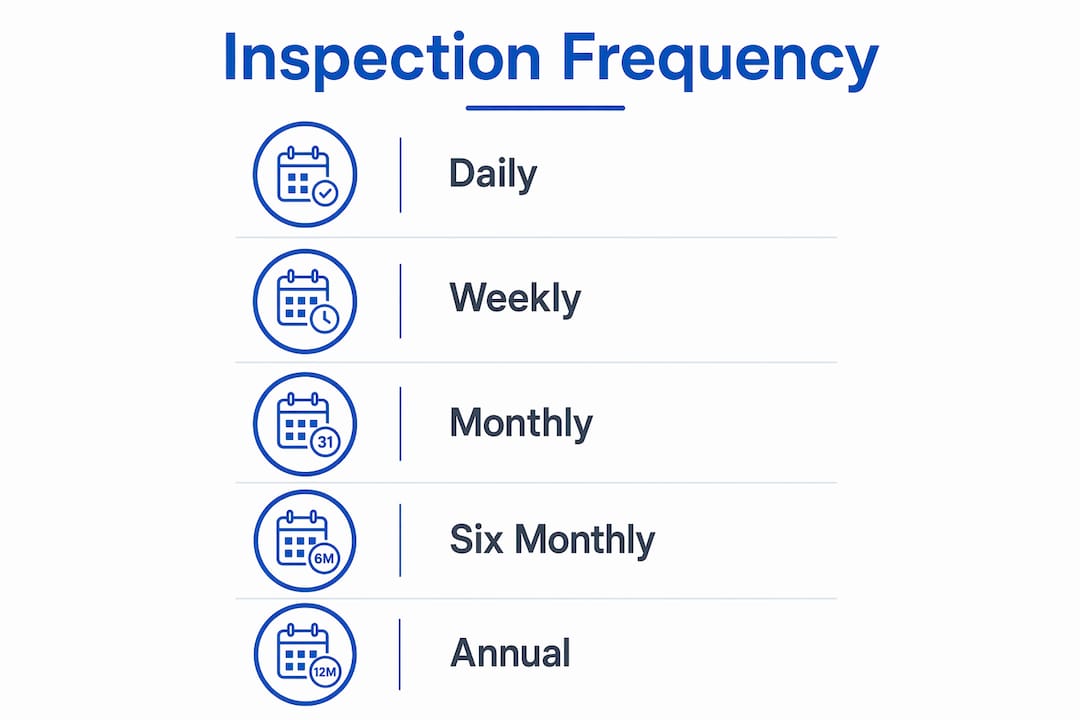
Inspection frequency is not one-size-fits-all. Fire safety maintenance in offices follows strict intervals: daily visual checks, weekly manual tests of call points, and professional servicing every six months, all under BS 5839-1. Formal fire code inspections typically occur every one to three years, depending on local regulations and occupancy risk.
| Compliance area | Typical frequency |
|---|---|
| Fire alarm visual check | Daily |
| Fire alarm call point test | Weekly |
| Fire alarm professional service | Every 6 months |
| Emergency lighting test | Monthly brief test and annual full-duration test |
| Fixed wire electrical testing | Typically every 5 years, or sooner depending on risk, occupancy or previous findings |
| Portable appliance testing (PAT) | Risk-based, depending on equipment type and use |
| Fire risk assessment review | Reviewed regularly and whenever significant changes occur; many organisations adopt an annual review as good practice |
| Fire door inspection | Periodically, based on the building’s fire risk assessment and maintenance strategy; six-monthly inspections are widely adopted as good practice |
| Water hygiene / Legionella monitoring | Risk-based, in line with the Legionella risk assessment and written control scheme |
| Asbestos management review | Regularly reviewed and updated when the building condition or use changes |
| Lifting equipment / passenger lifts | Thorough examination typically every 6 months for passenger lifts, or in accordance with LOLER requirements |
| Building fabric, roof and drainage checks | Planned routine inspections, with additional checks after severe weather or reported defects |
| Accessibility checks | Periodically reviewed, especially following layout changes, refurbishments or access complaints |
The table below shows typical inspection frequencies for the most common compliance areas in UK office buildings.
The appropriate schedule will depend on the building type, occupancy, risk profile, equipment installed, previous inspection findings and any requirements set out in the relevant risk assessments or maintenance strategy.
Compliance management is moving towards risk-calibrated, asset-based inspection schedules rather than rigid fixed intervals. A high-occupancy office with a complex fire suppression system needs more frequent attention than a small single-floor unit. Building type, occupancy level, and local authority requirements all affect the right schedule for your estate.
💡 OPSG Pro Tip: Don’t rely solely on diary reminders. Maintain a live compliance register showing the status of every inspection, certificate and remedial action across your estate. It provides a single source of truth during audits and inspections.
What are the risks of failing compliance checks?
Non-compliance carries consequences across four areas: legal, financial, operational, and reputational. Each one can cause serious damage on its own. Together, they can end a tenancy, void an insurance policy, or result in criminal prosecution.
The legal exposure is direct. Common failures identified during UK fire safety inspections include outdated risk assessments, poor fire door maintenance, inadequate service records, and blocked escape routes. Each of these can result in an improvement notice, a prohibition notice, or prosecution under the Regulatory Reform (Fire Safety) Order 2005.
In the UK, non-compliance can result in enforcement action, Improvement Notices, Prohibition Notices, prosecution and, in the most serious cases, unlimited fines through the courts. The financial impact often extends beyond legal penalties, including business interruption, increased insurance scrutiny, remedial works and reputational damage.
Operationally, failed inspections can force floor closures, disrupting hybrid and multi-location teams that depend on office availability. For a local authority or academy trust running services from a building, even a short closure creates significant disruption. Tenants may have grounds to withhold rent or terminate leases if a landlord cannot demonstrate a compliant building.
The most common failure points to watch for are:
- Outdated or unsigned fire risk assessments
- Fire doors with damaged seals, missing signage, or propped open
- Emergency lighting not tested or recorded
- Electrical certificates beyond their renewal date
- No documented evidence of contractor competency for recent works
How to embed compliance checks into daily operations
Compliance works best when it is treated as a continuous process, not a single annual event. Treating compliance as a tick-box task is the most common mistake facilities managers make. Embedding it into daily operations prevents the gaps that lead to failed inspections and enforcement action.
A practical approach follows these steps:
- Build a compliance calendar. Map every inspection, service, and certificate renewal date across your estate. Include lead times for booking contractors, completing remediation works, and retesting before the deadline.
- Plan for lead times. Compliance should be treated as a workflow with booking windows, remediation periods, and retesting built in. Waiting until a certificate expires before booking a contractor is how organisations end up non-compliant.
- Maintain the golden thread. Higher-risk buildings have specific Golden Thread duties under the Building Safety Act 2022. Even where those legal duties do not directly apply, maintaining accurate, accessible digital compliance records represents recognised best practice for commercial property portfolios. Digital records help facilities managers demonstrate compliance, track inspections and respond quickly during audits or enforcement visits.
- Use digital compliance management. Digital compliance solutions provide verifiable timestamps and detailed inspection histories, which regulators now prefer over paper records. Platforms that flag upcoming renewals and store contractor reports in one place reduce the risk of gaps.
- Manage tenant alterations carefully. Tenant-led fit-outs can invalidate fire safety permits and certificates, creating evidence gaps that only formal audits reveal. Any change to the building fabric or services should trigger a compliance review.
💡 OPSG Pro Tip: Assign a named compliance lead for each building in your estate. When accountability is shared across a team without a single owner, renewals get missed. One person, one building, one compliance log.
OPSG’s view on where compliance management is heading
The shift towards risk-based compliance is the most significant change we are seeing across the estates we support in Yorkshire and the North. Fixed annual cycles are giving way to schedules built around actual building risk, occupancy patterns, and asset condition. That is a better approach, but it demands more from facilities managers, not less.
The evidence gap created by tenant alterations is a problem we encounter regularly. A tenant installs a partition wall, moves a smoke detector, or fits a new door without notifying the landlord. The building’s fire risk assessment is now inaccurate, and nobody knows it until an inspector arrives. Formal, documented compliance checks are the only reliable way to catch these changes before they become enforcement issues.
Digital record-keeping is no longer a nice addition to a compliance programme. The Building Safety Act and its 2026 updates make the golden thread a legal requirement for higher-risk buildings, and regulators across all building types are moving in the same direction. If your compliance records live in a folder on someone’s desk, that is a risk in itself.
The facilities managers who avoid costly disruptions are the ones who treat compliance as part of their operational rhythm, not something they deal with when a certificate is about to expire. That mindset shift is the single most practical thing any estates team can do in 2026.
How OPSG supports compliance in UK office buildings

OPSG delivers compliance-led building checks, planned preventative maintenance, and reactive repairs for commercial landlords, local authorities, and facilities managers across Yorkshire and the North. Our teams carry out fire safety services, fire door inspections, electrical works, and building fabric maintenance with full documentation, RAMS, and job tracking at every stage.
For estates teams managing multiple buildings, our facilities management services provide a structured programme covering statutory compliance, scheduled servicing, and urgent repairs, all with clear reporting and communication from first contact through to completion. If your compliance calendar has gaps, or your records are not where they need to be, speak to OPSG about building a programme that keeps your buildings safe, legal, and well-documented.
Need support managing compliance across your office, commercial estate or managed property portfolio? OPSG works with facilities managers, commercial landlords and public sector organisations to deliver practical, compliance-led maintenance programmes that help keep buildings safe, compliant and operational.
Key takeaways
Regular compliance checks protect office buildings, their occupants, and their owners from legal, financial, and operational consequences that are entirely avoidable with a structured, documented inspection programme.
| Point | Details |
|---|---|
| Statutory compliance is a legal duty | UK law requires documented inspections across fire, electrical, structural, and accessibility systems. |
| Frequency must match building risk | Inspection schedules should reflect occupancy, building type, and asset condition, not just fixed annual dates. |
| Documentation is the evidence | Missing or outdated records are the most common trigger for enforcement action and prosecution. |
| Digital records are now the standard | Digital record keeping is increasingly recognised as best practice, particularly for higher-risk buildings and larger estates. |
| Tenant changes reset compliance status | Any fit-out or alteration requires a compliance review to avoid invalidating existing certificates. |
Common Mistakes We See
- Allowing inspection certificates to expire before booking contractors.
- Treating reactive repairs as a substitute for planned maintenance.
- Failing to review compliance after tenant alterations.
- Keeping certificates in multiple locations.
- Assuming contractors retain compliance records indefinitely.
- Not closing out remedial actions following inspections.
Why Trust OPSG?
At OPSG, we believe compliance isn’t a box-ticking exercise—it’s about protecting people, buildings and reputations. We work alongside facilities managers, schools, healthcare providers and commercial property owners across Yorkshire and the North to deliver compliant maintenance, specialist inspections and practical building solutions backed by clear documentation and professional standards.
Whether you need advice on planned maintenance, fire safety, roofing, drainage or wider building compliance, our team is here to help.
FAQ
What does a compliance check cover in an office building?
A compliance check covers fire safety systems, electrical records, structural condition, accessibility provisions, risk assessments, and service documentation. Each area has its own inspection frequency and regulatory standard under UK law.
How often are fire safety checks required in UK offices?
BS 5839-1 requires daily visual checks, weekly call point tests, and professional servicing every six months. Formal fire risk assessment reviews are required annually or after any significant change to the building or its use.
What happens if an office building fails a compliance inspection?
Failure can result in an improvement notice, a prohibition notice, prosecution under the Regulatory Reform (Fire Safety) Order 2005, or temporary closure. Insurance policies may also be voided if compliance certificates have lapsed.
Why do tenant alterations affect building compliance?
Tenant-led fit-outs can move or obstruct fire detection equipment, alter escape routes, or invalidate existing fire safety permits. These changes require new inspections and updated risk assessments to restore compliance status.
What is the golden thread in building safety?
The golden thread is the complete, accessible record of a building’s safety information maintained throughout its lifecycle. Under UK building safety regulations, this must be held in digital form for higher-risk buildings and is increasingly expected across all commercial premises.